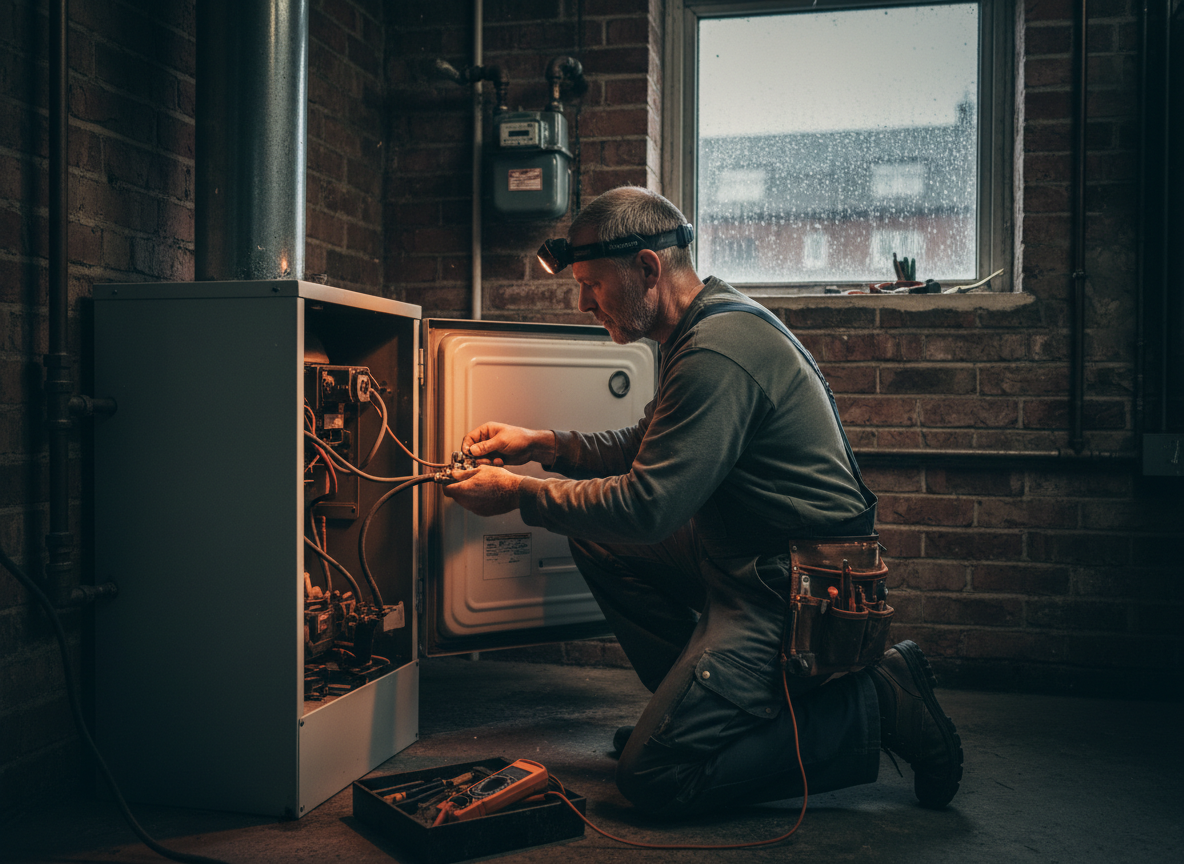
Manchester homes built before the 1980s in neighborhoods like Buckland and the East Side often use older standing-pilot or early electronic ignition systems that fail when winter temperatures drop sharply. Humid continental conditions here cause condensation inside cabinets during shoulder seasons, corroding igniter terminals and shortening service life. Technicians at Hockanum River Heating carry both silicon-carbide and silicon-nitride replacements because the two materials behave differently once the furnace has cycled through repeated freeze-thaw cycles typical of Hartford County.
Access is frequently restricted in tight basements common to Downtown Manchester row houses, requiring removal of the burner assembly before the igniter can be tested with a microamp meter. Skipping this step leaves homeowners with recurring no-heat calls when the flame sensor cannot read the weak rectification signal created by a cracked igniter. Local code requires the furnace compartment door to be reinstalled with all gaskets intact after any ignition work to maintain combustion-air separation from living spaces.
East Hartford and Hartford commuters who live in Manchester often run their systems continuously from October through March, accelerating wear on the igniter lead wires that route near the heat exchanger. A failed igniter can also mask a failing gas valve, so every repair includes a combustion analysis before the unit is returned to service. These steps prevent the short cycling that damages heat exchangers in the area’s older forced-air systems.
Technician insight
In Manchester, the thing that catches most people out with Furnace Igniter Repair is the age of wiring in 1960s–1970s homes near Wickham Park. Humid summers corrode the igniter harness right where it passes the heat exchanger, so a new igniter fails within weeks unless the harness is replaced at the same time.
No-Heat Call on East Side
A Buckland homeowner reported the furnace running but no heat during an early cold snap. Inspection showed a cracked hot-surface igniter and oxidized wiring harness. The harness was replaced along with the igniter, the combustion analysis confirmed proper flame signal, and the system stayed online through the rest of the winter.
Furnace Igniter Repair Services We Offer
✓Hot Surface Igniter Replacement
Direct replacement of cracked silicon-carbide or silicon-nitride igniters that no longer glow during the trial-for-ignition period in Manchester furnaces.
✓Intermittent Pilot Ignition Repair
Restoration of spark and flame-sensing circuits on standing-pilot conversions common in Buckland and East Side homes built in the 1970s.
✓Igniter Circuit Diagnostics
Voltage-drop and microamp testing of control-board outputs, wiring harnesses, and limit switches that prevent igniter operation during cold snaps.
✓Flame Sensor and Igniter Assembly Cleaning
Removal of oxidation and soot from the flame rod and igniter base to restore reliable rectification signals in humid Manchester basements.
✓Direct Spark Ignition Module Service
Replacement or recalibration of DSI modules that fail to generate spark when outdoor temperatures fall below freezing in Hartford County.
How it works
- 1
Initial Safety And Visual Inspection
Technician verifies gas supply, electrical disconnect, and thermostat demand, then inspects the igniter for visible cracks or carbon tracking.
- 2
Igniter And Control Testing
Microamp and voltage readings are taken at the igniter leads and control board to isolate whether the igniter, wiring, or module has failed.
- 3
Component Replacement
Failed igniter or related parts are swapped using manufacturer-specified torque and gap settings for the specific furnace model.
- 4
Combustion And Operation Verification
Furnace is run through multiple cycles while monitoring flame signal and checking for proper draft and limit switch function.
Pricing
Cost depends on igniter material, furnace access in older Manchester basements, and whether wiring or module replacement is also required.